Training Unit 02
Semantic Identity
How Intelligence Becomes Recognizable
Identity in the intelligence era is recognized through patterns, not declared through credentials.
Video
Module 02
Diagram
Visual Model
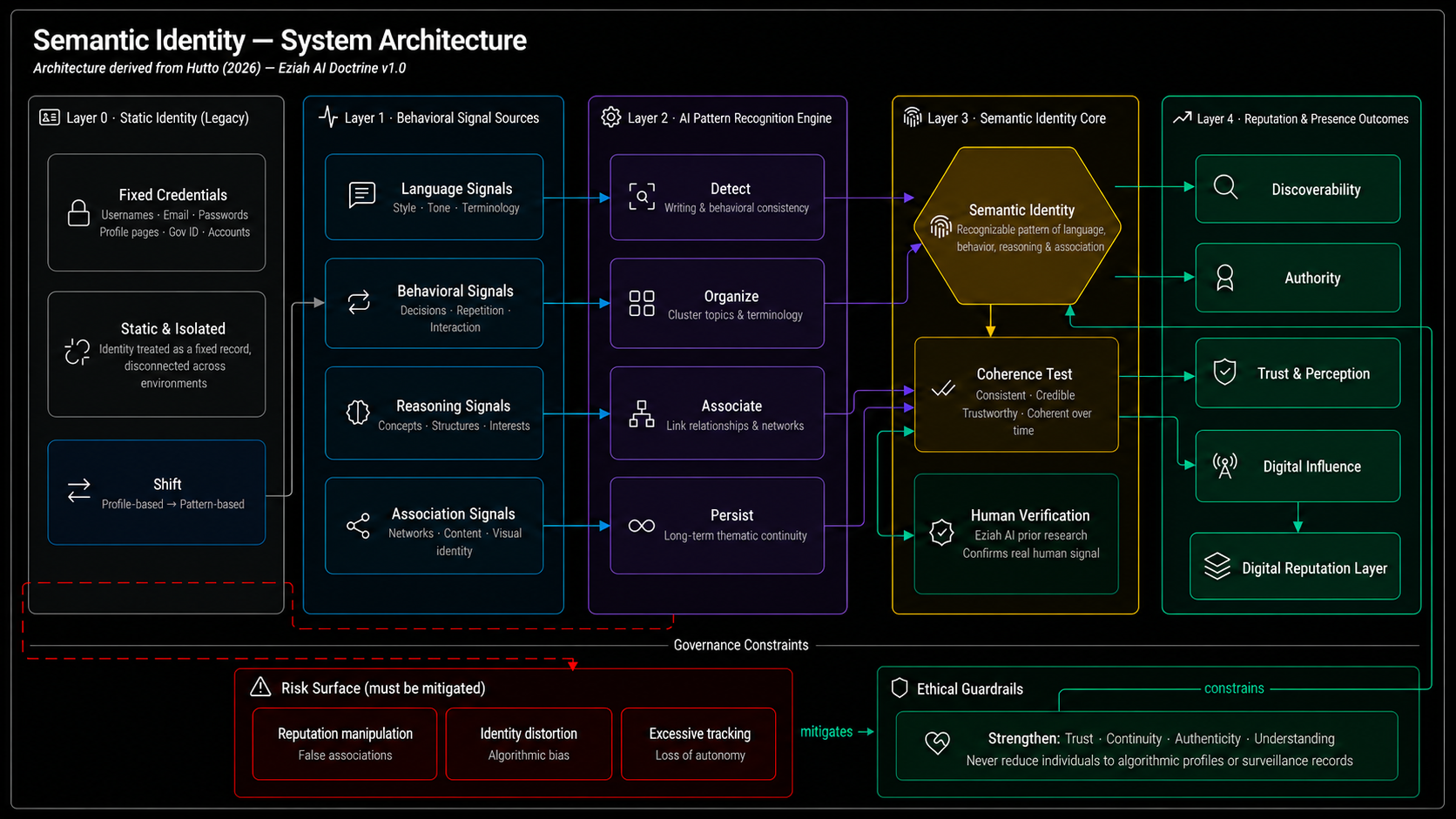
Definitions
Key Definitions
- Semantic Identity
- The recognizable pattern of language, behavior, reasoning, and association that identifies a person or entity across digital systems.
- Static Identity
- Legacy identity treated as a fixed record — usernames, accounts, profile pages, credentials — disconnected across environments.
- Behavioral Signal
- The decisions, repetitions, and interactions that accumulate into a consistent, machine-readable pattern over time.
- Coherence
- The test intelligent systems apply to a pattern: is it consistent, credible, trustworthy, and stable across time and context?
- Digital Reputation Layer
- The downstream outcome of coherent semantic identity — discoverability, authority, trust, and influence inside AI-mediated systems.
Exposition
What this explains
- Why credentials stopped being a reliable description of who someone is.
- How AI systems detect, organize, associate, and persist identity patterns.
- Why coherence over time carries more weight than any single action.
- How recognition converts into discoverability, authority, and influence.
Stakes
Why this matters
The semantic identity layer sets the terms for:
- Whether AI systems can recognize a person consistently across platforms.
- How authority is assigned when profiles no longer carry the signal.
- Whether reputation can be manipulated through false association.
- Whether pattern recognition drifts into surveillance or distortion.
- How institutions and creators establish credible digital presence.
- The governance constraints that keep identity systems from reducing people to profiles.
Transcript
Public Transcript
Read the Full TranscriptComplete text of the lesson · 114 timecoded lines
Complete text of the lesson · 114 timecoded lines
Semantic Identity — Public Transcript
00:03Semantic identity.
00:04Long before the internet, people recognized one another through patterns.
00:08You know someone by the way they speak, what they notice, how they explain an
00:12idea, and how they respond under pressure.
00:14No single action proves who they are.
00:16Recognition forms through repetition.
00:19The digital world was built differently.
00:21Online identity was reduced to fixed credentials: a name, an account,
00:25a password, or an identification number.
00:27Those tools can confirm access.
00:29But they cannot fully explain who is acting, what remains consistent,
00:33or whether the same reasoning structure continues over time.
00:36In Module 1, we established that the future web will need trusted human signal.
00:41But a signal has limited value if it cannot be connected across time.
00:45A comment may be human.
00:47A decision may be human.
00:48A piece of work may be human.
00:50The next question is whether those actions belong to a recognizable
00:53and accountable pattern.
00:55What remains consistent enough to be recognized over time?
00:58That is the problem of semantic identity.
01:00Semantic identity is the recognizable pattern formed by a person's recurring
01:04language, reasoning, choices, relationships, and values
01:08across contexts and over time.
01:10A profile tells a system what you claim about yourself.
01:13A pattern shows what you repeatedly do. The difference matters.
01:16A biography may say that someone values careful reasoning.
01:19Their long-term work may show whether that claim is true.
01:22A username may remain the same while the person using it changes.
01:26A password may be stolen while the real person's history, judgment,
01:30and relationships remain distinct.
01:32Semantic identity does not replace legal identity or account security.
01:36It adds another layer.
01:38It asks whether a digital presence has continuity.
01:41That continuity forms from many small signals: the language a person returns to,
01:45the questions they keep asking, the standards they apply,
01:48the people and communities they engage with, the choices they make when
01:52no single choice seems important.
01:54Over time, these signals can form a recognizable structure.
01:57Humans have always recognized patterns in one another.
02:00Artificial intelligence changes the scale of that recognition.
02:03A person may remember a few conversations.
02:06A machine can compare years of text, images, actions, and relationships
02:10across large digital systems.
02:12It can detect repeated phrases, shared themes, changes in tone,
02:17and patterns of association.
02:18This can help establish continuity.
02:20It can also create false confidence.
02:23A system may detect a pattern without understanding the person.
02:26It may mistake repetition for intent.
02:28It may treat an old interest as a permanent identity.
02:31It may connect actions that belong to different contexts.
02:34AI makes semantic patterns easier to see.
02:37It does not make every interpretation of those patterns correct.
02:40That distinction is essential.
02:41Trust, reputation, and accountability.
02:44Semantic identity matters because digital trust is moving beyond simple claims.
02:49Reputation is no longer shaped only by what appears on a profile page.
02:53It is also shaped by the record of what a person creates, supports,
02:57repeats, Corrects, and accepts.
02:59This means authority can become more evidence-based.
03:01A body of work can show continuity.
03:03A long-term pattern of judgment can support credibility.
03:06A stable network of relationships can provide context.
03:09But semantic identity is not proof of humanity by itself.
03:13Synthetic systems can copy a writing style.
03:16They can repeat themes.
03:17They can imitate parts of a public pattern.
03:19A pattern can support trust.
03:21It cannot replace proof.
03:22Human verification asks whether accountable human
03:25participation is present.
03:26Semantic identity asks what connects that participation across time.
03:30The 2 concepts strengthen each other, but they are not the same.
03:34The same system that recognizes continuity can also distort it.
03:38A few clicks can be treated as a lasting preference.
03:41A temporary mistake can become a permanent label.
03:44False associations can damage reputation.
03:48Old information can follow a person after they have changed.
03:52A platform can reduce a complex human life to a prediction score.
03:56This is where recognition becomes surveillance.
03:59Semantic identity should not mean that every action must be collected.
04:03No app or website should get to slap a permanent label on you without
04:07letting you defend yourself.
04:08It should not turn past behavior into a fixed boundary around future opportunity.
04:13People change.
04:14Context matters.
04:15Identity is continuous, but it is not frozen.
04:18A serious semantic identity system must allow correction, consent,
04:22context, and proportion.
04:24It should recognize meaningful continuity without claiming to
04:27capture the whole person.
04:29The goal is not total visibility; the goal is trustworthy continuity.
04:33A well-designed system should ask only for the signals required for
04:37the decision being made.
04:38A marketplace may need to know whether a seller has a reliable history; it does not
04:42need access to every private conversation.
04:45A learning platform may need to know whether a piece of work reflects a
04:48student's development; it does not need to turn that student into a
04:52permanent behavioral profile.
04:53Recognition should be limited to purpose, and trust shouldn't require
04:57you surrendering yourself.
04:59The old web treated identity as something stored inside an account.
05:02The next web will increasingly treat identity as a pattern
05:05that develops across time.
05:07That pattern can strengthen trust, preserve authorship,
05:10and support accountability.
05:11It can also become a tool of control if systems confuse
05:15recognition with ownership.
05:16Semantic identity should help the digital world recognize continuity without
05:21deciding the limits of the person.
05:23The defining question is no longer only, who do you claim to be?
05:26It is, what will remain consistent enough to be recognized over time?
05:31This is Semantic Identity, Module 2 of the Eziah AI Doctrine series.
Source Doctrine
Source Paper
This training lesson is based on the original Semantic Identity research published on Eziah.ai. Eziah.ai defines the term. Eziah.live trains the thinking behind it.
Ontology
Ontology bridge
Semantic Identity is a defined term in the Eziah ontology. The canonical definition lives on Eziah.ai.
Related
Related concepts
Next
Next Training Session
The recommended next session is Training Unit 03 — Identity Clusters.
Return