Training Unit 03
Identity Clusters
How Digital Identity Becomes Organized Through Association
Association is context. Repeated connection carries weight; a single interaction does not.
Video
Module 03
Diagram
Visual Model
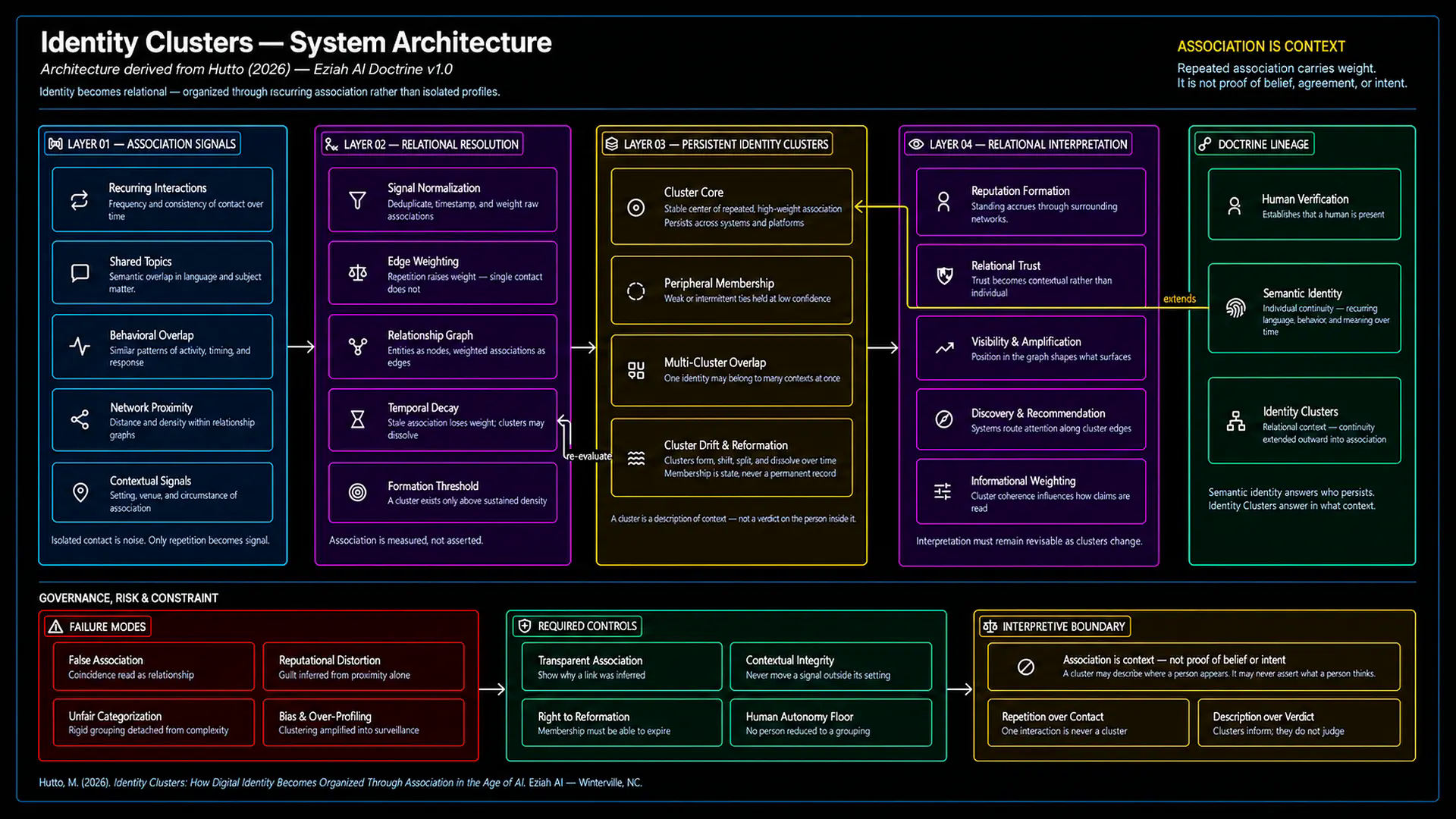
Definitions
Key Definitions
- Identity Cluster
- A recurring network of people, behaviors, ideas, and contexts connected through meaningful patterns of association.
- Association Signal
- Recurring interactions, shared topics, behavioral overlap, network proximity, and contextual setting. Isolated contact is noise; only repetition becomes signal.
- Relational Resolution
- The measurement layer: normalizing raw associations, weighting edges by repetition, building the relationship graph, decaying stale ties, and applying a formation threshold.
- Cluster Drift
- Clusters form, shift, split, and dissolve over time. Membership is a state, never a permanent record.
- Interpretive Boundary
- A cluster describes where a person appears. It never asserts what a person believes, agrees with, or intends.
Exposition
What this explains
- Why a single interaction is not a relationship, and why repetition is.
- How systems normalize, weight, and decay association into a relationship graph.
- How persistent clusters form, overlap, drift, and dissolve over time.
- How relational position shapes reputation, visibility, and discovery.
Stakes
Why this matters
The relational identity layer sets the terms for:
- Whether trust is read as contextual rather than absolute.
- How attention and recommendation are routed along cluster edges.
- Whether coincidence gets misread as relationship.
- Whether proximity alone becomes grounds for inferred guilt.
- Whether people can leave a grouping they have outgrown.
- The governance controls that keep clustering from becoming surveillance.
Transcript
Public Transcript
Read the Full TranscriptComplete text of the lesson · 99 timecoded lines
Complete text of the lesson · 99 timecoded lines
Identity Clusters — Public Transcript
00:03Identity Clusters.
00:05Identity does not exist alone.
00:07Every person exists inside relationships.
00:09The people we learn from, the communities we return to,
00:12the ideas we engage with, the institutions we trust— these
00:16connections do not define a person, but they provide context.
00:20For much of the early internet, digital identity was treated as something
00:23isolated— one account, one profile, History of activity.
00:28Systems could examine what an account did without fully understanding
00:31the network around it. That is becoming less true.
00:34In the previous module, we established semantic identity— the
00:38recurring pattern of language, reasoning, choices, relationships,
00:42and values that creates recognizable continuity across time.
00:46But continuity does not develop in isolation.
00:49People interact, ideas spread, communities overlap, Relationships repeat,
00:54and repeated connections create structure.
00:56This is where identity clusters emerge.
00:58An identity cluster is a recurring network of people, behaviors, ideas,
01:03and contexts connected through meaningful patterns of association.
01:08The important word is meaningful.
01:09One interaction is not a relationship.
01:11Reading an idea does not mean supporting it.
01:14Replying to someone does not mean agreeing with them.
01:17A single connection may mean very little.
01:19Repeated connections can reveal structure.
01:22Over time, systems can detect who repeatedly interacts with whom,
01:26which communities overlap, which ideas appear together,
01:29and which relationships continue.
01:31This gives digital identity a relational layer.
01:34Relational context can reveal what an isolated profile cannot.
01:38It can show whether activity has history, whether relationships persist,
01:42and whether a digital presence belongs to a broader pattern.
01:45The question is no longer only, what does this account do?
01:49It can also become, what patterns surround it?
01:522 people may never directly speak, but they may return to the same sources,
01:57participate in similar communities, engage with related ideas,
02:01and interact with the same people.
02:03A system may recognize that they occupy nearby positions inside a larger network.
02:08That proximity has meaning, but its meaning has limits.
02:12Being close inside a network does not make 2 people identical.
02:15It does not prove shared beliefs or motives.
02:18Association is evidence of context; it is not proof of belief.
02:22Artificial intelligence increases the scale at which these
02:25relationships can be detected.
02:27A person can understand the structure of a small community; a machine can compare
02:31patterns across large networks.
02:34It can identify repeated interactions, shared topics, behavioral overlap
02:39and recurring relationships.
02:40This provides useful context.
02:42It can also produce mistakes because seeing a connection is not
02:46the same as understanding it.
02:47A journalist may repeatedly interact with people they investigate.
02:51A researcher may spend years studying ideas they reject.
02:55The relationship may be real.
02:57The interpretation may still be wrong.
03:00That distinction matters when relational patterns begin to influence
03:04reputation and trust.
03:06A body of work provides evidence.
03:09Long-term relationships provide context.
03:12Repeated participation can show whether someone has a place inside a community.
03:17These signals can help establish whether an account has history,
03:21whether relationships persist, and whether its activity
03:24exists inside a stable network.
03:27That can improve how systems evaluate credibility and trust.
03:31But an identity cluster cannot answer every question about the person inside it.
03:37A cluster is not a verdict.
03:39If a system treats everyone near a harmful actor as harmful,
03:43association becomes guilt.
03:46If disagreement is mistaken for support, context disappears.
03:51If one interaction becomes a permanent classification,
03:54a weak signal becomes a strong conclusion.
03:57A serious identity cluster system must use association with restraint.
04:03Repeated relationships should carry more weight than isolated contact,
04:07context should matter before conclusions are drawn.
04:11Associations should be allowed to weaken or change over time
04:16and group membership should never become automatic proof of individual intent.
04:20Human beings are influenced by their networks.
04:23But they are not reducible to them.
04:26This gives us 3 connected layers.
04:28Human verification asks whether accountable human
04:32participation is present.
04:34Semantic identity asks what remains consistent about that
04:37participation across time.
04:40Identity clusters ask what recurring relationships and contexts surround it.
04:45Participation, continuity.
04:48Relational context.
04:50Each layer answers a different question, and none should be mistaken
04:54for the whole identity.
04:56The old web often treated identity as an isolated account.
05:00The emerging web can increasingly recognize identity inside networks.
05:05That can strengthen context, discovery, reputation, and trust, but only if
05:10association is interpreted with restraint.
05:14Identity clusters should help systems understand the relationships around a
05:17person, Without allowing those relationships to define the whole person.
05:21Because knowing who surrounds someone is useful.
05:24Knowing what those relationships actually mean is harder,
05:27and that difference matters.
05:29This is Identity Clusters.
05:31Module 3 of the Eziah AI Doctrine Series.
Source Doctrine
Source Paper
This training lesson is based on the original Identity Clusters research published on Eziah.ai. Eziah.ai defines the term. Eziah.live trains the thinking behind it.
Ontology
Ontology bridge
Identity Clusters is a defined term in the Eziah ontology. The canonical definition lives on Eziah.ai.
Related
Related concepts
Next
Next Training Session
The next training unit in the Eziah.live sequence is in production and will link here once published.
Return