Training Unit 01
Human Verification
Why AI Needs Trusted Human Signal
AI systems cannot coordinate safely at scale without trusted human signal.
Video
Module 01
Diagram
Visual Model
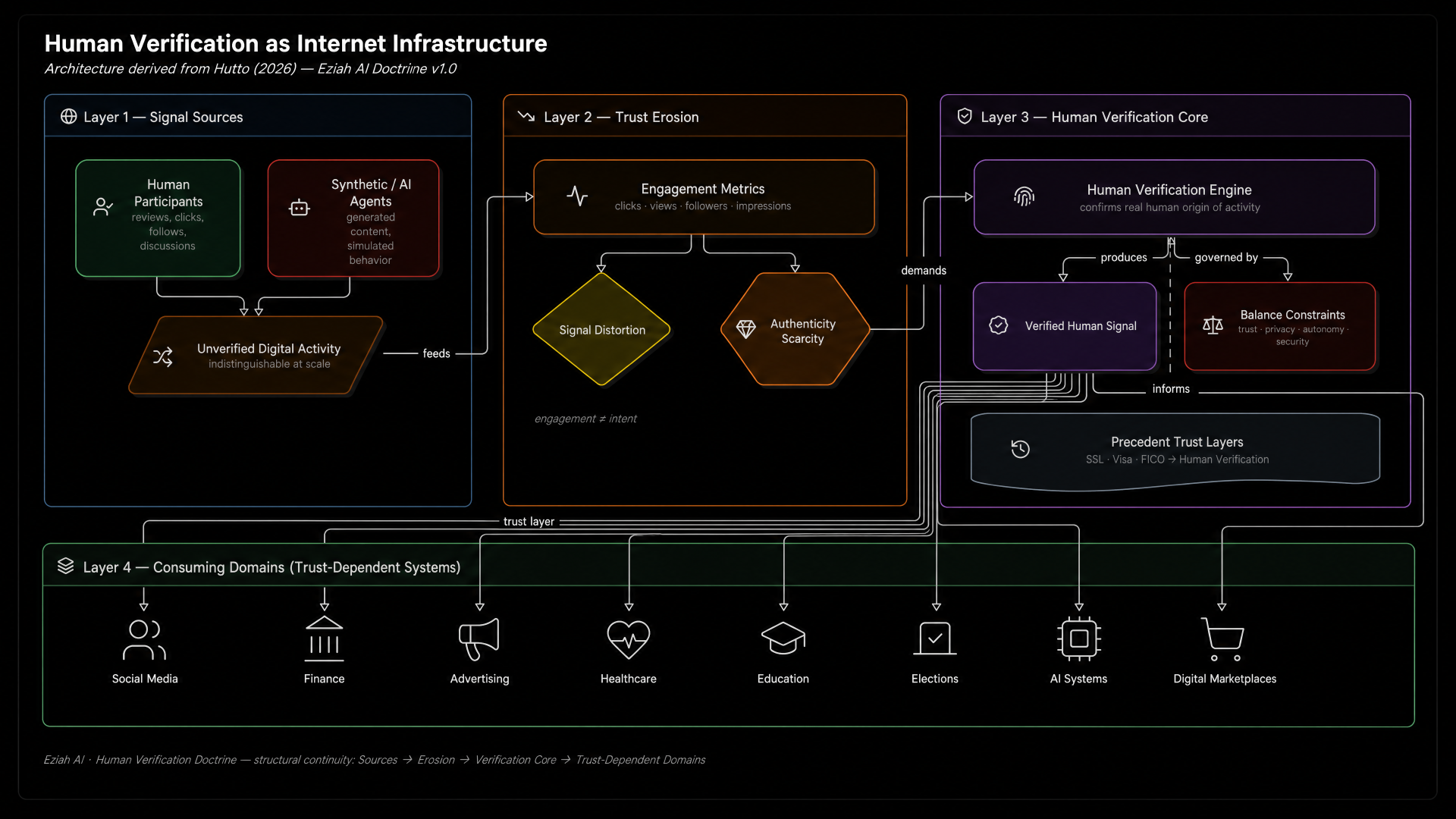
Definitions
Key Definitions
- Human Verification
- Confirming that a signal, action, or contribution comes from a real, accountable human — not a model, script, or synthetic identity.
- Trusted Human Signal
- Verified human input that AI systems, platforms, and institutions can weight and cite without collapsing into synthetic feedback loops.
- Proof-of-Human
- The cryptographic, behavioral, and social evidence that shows a signal was produced by a distinct human.
- Identity Signal
- The provenance metadata attached to a contribution — who, when, under what conditions — that lets downstream systems reason about trust.
- Verification Layer
- The shared substrate across platforms and models that decides whether a signal carries trusted human origin before it enters coordination.
Exposition
What this explains
- Why AI systems struggle with trust at scale.
- Why identity matters inside intelligent systems, not just around them.
- Why provenance and verification become infrastructure, not features.
- Why human signal stays essential as models grow more capable.
Stakes
Why this matters
The verification layer sets the terms for:
- AI systems that must weigh human input against synthetic input.
- Platforms hosting a mix of human and machine contribution.
- Institutions extending their legitimacy into digital spaces.
- Creators proving authorship inside generative environments.
- Digital trust as public infrastructure.
- Future governance of coordinated intelligent systems.
Transcript
Public Transcript
Read the Full TranscriptComplete text of the lesson · 8 sections
Complete text of the lesson · 8 sections
Human Verification in AI — Public Transcript
Opening
Human Verification in AI.
The internet is entering a fundamental shift.
For decades, digital systems assumed that most online activity came from real people.
A click, a comment, a review, a view, a follow.
Each one carried a basic assumption: a human was behind the signal.
But artificial intelligence is breaking that assumption.
So the first question of the AI-era internet is simple:
Are you a real person?
That question may sound simple, but it is becoming one of the most important trust problems facing digital platforms.
As artificial intelligence becomes faster, cheaper, and more capable, the internet is losing its ability to reliably determine whether engagement, traffic, or participation is actually coming from a human being.
The foundational trust of the web is beginning to crack.
To understand why, we need to break the problem into five parts.
The Five Parts
First, the invisible assumption.
Second, the synthetic tsunami.
Third, why metrics lose meaning.
Fourth, the human trust layer.
And finally, the ethical balancing act.
Section One: The Invisible Assumption
For most of internet history, human participation was assumed by default.
Before we go further, we need a clear definition.
Human verification is the process of confirming that digital activity, interaction, or participation originates from a real human being rather than an automated or synthetic system.
This matters because the internet was not originally built for a world where synthetic systems could imitate human behavior at scale.
When someone left a review, clicked an ad, joined a forum, watched a video, or commented on a post, platforms generally treated that activity as authentic.
Bots existed, but they were limited.
They were easier to detect, easier to filter, and easier to separate from normal human behavior.
Today, that assumption no longer holds.
We are moving from assumed humanity to synthetic systems that can imitate participation at near-zero cost.
Most digital systems were not built for this reality.
Which brings us to section two: the synthetic tsunami.
Section Two: The Synthetic Tsunami
We are no longer dealing only with basic spam bots.
Modern AI can generate fake engagement, synthetic audiences, automated comments, AI-generated influencers, fake product reviews, and artificial traffic.
This creates a new kind of pressure on digital platforms.
They can no longer easily separate real participation from synthetic activity.
And when synthetic activity scales, the meaning of digital participation begins to change.
Section Three: When Metrics Lose Meaning
For years, internet platforms measured success through visible activity.
Clicks, watch time, impressions, followers, comments, engagement.
These metrics shaped advertising, reputation, influence, platform growth, and economic value.
But the AI era changes what those numbers mean.
The old question was: How much activity happened?
The new question is: Did that activity come from real human intent?
Now we can have views without real human attention.
Comments without humans behind the keyboard.
Traffic surges without actual consumer intent.
And engagement numbers that look impressive but carry very little trust.
Visibility no longer guarantees authenticity.
Engagement no longer automatically equals human intent.
In this cognitive era, relying only on old engagement metrics becomes economically unreliable.
Section Four: The Human Trust Layer
If the old metrics are breaking, the solution is not simply more content.
The solution is better trust infrastructure.
This is where the problem becomes architectural.
The future web needs a way to verify digital activity itself.
That leads to the central question: What happens when intelligence costs almost nothing?
When a persuasive paragraph, image, comment, review, or message can be generated in seconds, what still retains value?
Montrel Hutto, founder of Eziah AI, compresses the shift this way:
In the age of AI, the scarce resource is no longer information. It is verified human signal.
That is the paradigm shift.
As the cost of generating intelligence moves towards zero, the value of authentic human signal rises.
This is why verified human signal becomes the foundation of the next trust layer.
The idea of a trust layer is not new.
The web has needed trust infrastructure before.
Secure websites needed systems that verified safe connections.
E-commerce needed systems that verified payments.
Credit markets needed systems that helped standardize financial trust.
Now the AI-era internet needs a new trust layer, one that can verify digital activity itself.
Human verification is not only about keeping spam off social media.
It will matter across finance, advertising, healthcare, education, democratic elections, digital marketplaces, and the training ground for future AI systems.
Every system that depends on human feedback will need a way to know whether that feedback is actually human.
The future internet will increasingly prioritize trusted participation, reliable human feedback, and credible digital presence over raw volume.
Section Five: The Ethical Balancing Act
Human verification is necessary, but if it is designed poorly, it can become dangerous.
The goal is not to prove humanity at all costs.
The goal is trust without losing freedom.
A serious human verification layer must protect trust, privacy, autonomy, and security at the same time.
A bad system could create excessive surveillance.
It could weaken privacy.
It could centralize control over who gets to speak.
And it could exclude vulnerable people from digital participation.
That is the risk.
The solution has to strengthen digital trust without creating abusive identity systems.
Human verification must protect authentic participation without turning the internet into a checkpoint.
The Larger Shift
Here is the larger shift.
The internet is moving from information abundance to trust scarcity.
For decades, the central challenge was producing, organizing, and distributing information.
Today, synthetic systems can produce content at massive scale, so the challenge is changing.
The challenge is no longer only creating more content.
The challenge is determining what is actually real.
The future internet will not be defined by who generates the most content.
It will be defined by who can establish the most trusted human signal.
The era of engagement for engagement's sake is ending.
The era of verified humanity is beginning.
The infrastructure of the web is changing beneath us.
And that leaves one final question:
Are you ready for the trust economy?
This is Human Verification in AI, Module 1 of the Eziah AI Doctrine Series.
Source Doctrine
Source Paper
This training lesson is based on the original Human Verification research published on Eziah.ai. Eziah.ai defines the term. Eziah.live trains the thinking behind it.
Ontology
Ontology bridge
Human Verification is a defined term in the Eziah ontology. The canonical definition lives on Eziah.ai.
Related
Related concepts
Next
Next Training Session
The recommended next session is either Semantic Identity or Identity Clusters. Both training units are published and available now.
Return